
What to focus on in your final 21 days
Repair. Practise. Rehearse.
Use PrepPals’ 21-day CSCA study plan to set weekly priorities, build a daily routine and track Mathematics, Physics and Chemistry revision.
- Days 1–7Find & repair gaps
- Days 8–14Choose & apply methods
- Days 15–21Rehearse & review
Before Day 1
- Confirm your required subjects and test language.
- Try a short question set to find your starting point.
- Choose a daily study window you can sustain.
Confirm your CSCA subject requirements, then choose syllabus topics for these three weeks.
Find your starting point
Target repeat errors
Review familiar topics briefly, then retry recurring mistakes
Practise unaided
Explain an example, cover the solution, then solve a similar question
Build the essentials
Prioritise core topics and set a realistic target for these three weeks
Three weeks: repair, practise, rehearse
- Days 1–7
Find & repair gaps
Find the gaps that block your next question.
- Sort topics: secure / needs practice / needs help.
- Repair the idea behind a mistake.
- Try a fresh question without notes.
Your checkpointCan I explain the method and use it unaided?
- Days 8–14
Choose & apply methods
Move from recognising a solution to choosing one.
- Explain why the method fits.
- Mix today’s topic with an earlier one.
- Record the cause; retry after a gap.
Your checkpointCan I choose a method without a topic label?
- Days 15–21
Rehearse & review
Check accuracy and pacing, then repair what remains.
- Check your remaining syllabus gaps.
- Review a timed attempt before the next.
- Retry repeat errors; keep Day 21 lighter.
Your checkpointDo I know my repeat errors and how to avoid them?
A 90-minute routine for each subject
For shorter sessions, reduce each block and keep the four steps: recall, understand, practise and repair.
- 10 min
Recall
Write what you remember without notes. Check the gaps.
- 20 min
Understand
Explain one worked example and when its method applies.
- 40 min
Practise
Try related questions unaided, including an earlier topic.
- 20 min
Repair
Find the cause, correct it and schedule a retry.
One topic needs more than one visit
Learn it
Explain one example. Solve a fresh question.
Next session
Try again without notes. Repair the stuck step.
Later this week
Choose the method inside a mixed question set.
Turn an error into a next step
What happened?
I used a logarithm rule on an invalid expression.
Why?
I started manipulating before checking the domain.
What changes next time?
Write the domain first; retry a similar question later without notes.
Why recall, practice and repeat visits?
Retrieve before rereading
Try closed-note recall, then correct it. Dunlosky and colleagues rated practice testing and distributed practice highly. [04]
Move from examples to answers
Explain an example, then try a related question independently. The IES guide recommends alternating examples and problem solving. [02]
Return after a gap
Revisit earlier work after a gap. The IES guide recommends spacing learning over time. [02]
Math, Physics & Chemistry: what to revise
Mathematics
Connect sets and functions, then trigonometry and sequences, before geometry, probability and mock review. [01]
- Days 1–7
Connect sets & functions
- Review sets, function operations, composition and properties.
- Match linear, quadratic, power, exponential and logarithmic functions to graphs.
- Check domains and basic algebra before moving into trigonometry.
Keep at week’s endA function summary and basic questions solved without notes.
- Days 8–14
Connect trigonometry & sequences
- Use identities, angle formulas and equations in questions.
- Practise terms, sums and inequalities in arithmetic and geometric sequences.
- Retry function and algebra errors from the first week.
Keep at week’s endExplained trigonometry and sequence solutions, with corrected errors.
- Days 15–21
Geometry & mock review
- Connect lines, circles, conic sections, vectors and complex numbers.
- Practise counting, probability, solid geometry and basic derivatives.
- Complete a mock before Day 21; finish with its corrections.
Keep at week’s endA reviewed mock and a concise conditions-and-error sheet.
A Mathematics check: domain before substitution
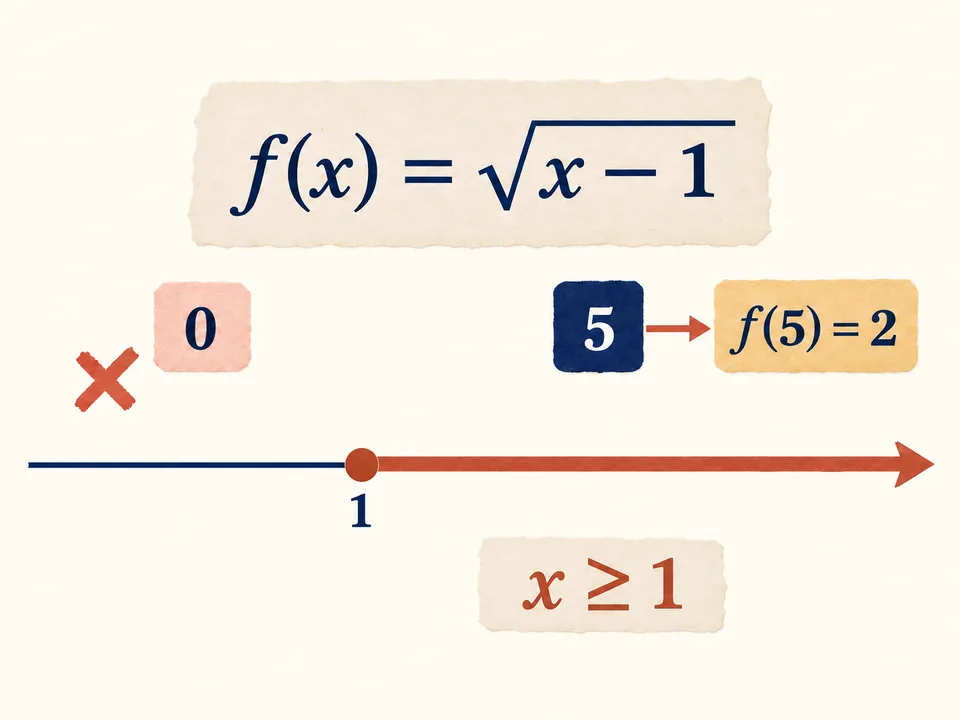
- For f(x) = √(x − 1), check the expression inside the square root first.
- From x − 1 ≥ 0, identify the domain x ≥ 1.
- Substitute an allowed value and explain why other values are excluded.
Physics
Keep all five areas on your coverage map: mechanics, electromagnetism, thermal physics, optics and modern physics. [05]
- Days 1–7
Motion & forces
- Start with motion, acceleration and force analysis.
- Connect forces with projectile, circular and gravitational motion.
- Draw before calculating; flag models that need help.
Keep at week’s endA coverage map and models you can explain.
- Days 8–14
Energy, momentum & fields
- Connect energy and momentum, then oscillations and waves.
- Check mechanics gaps before electric fields.
- Explain an example; try a fresh question unaided.
Keep at week’s endIndependent solutions with a sketch, method and unit check.
- Days 15–21
Electricity, optics & review
- Review electricity, magnetism and induction, then optics.
- Check thermal and modern physics gaps on your syllabus map.
- Review timed work; use Day 21 for key corrections.
Keep at week’s endA reviewed timed attempt and a final model-and-error sheet.
A Physics check: forces before formulas
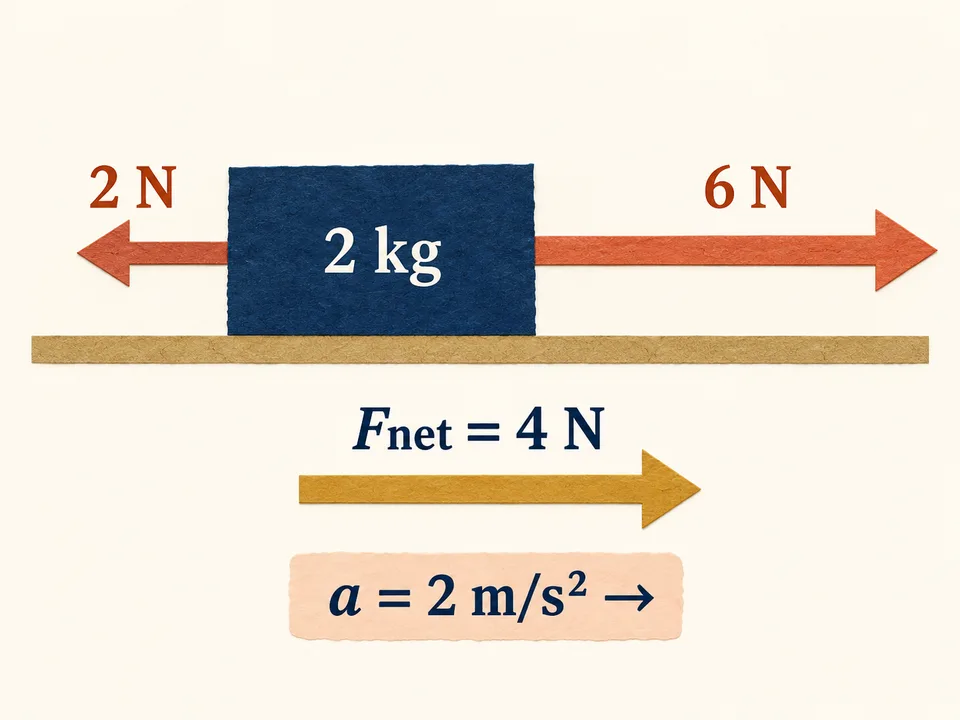
- Sketch the object and forces.
- Choose an axis and calculate the net force.
- Apply Fnet = ma; check the direction and unit.
Chemistry
Map concepts and calculations, substances and reactions, chemical principles, and experiments and applications. [06]
- Days 1–7
Make the language precise
- Use short questions to map your gaps.
- Connect symbols, equations, mole amounts and concentration.
- Explain the chemical statement before calculating.
Keep at week’s endA coverage map and notation-and-calculation summary.
- Days 8–14
Structure, principles & acids
- Connect atomic structure, periodic trends, redox and bonding.
- Move into reaction rates, equilibrium and acid–base questions.
- Mix new applications with earlier equation and quantity questions.
Keep at week’s endExplanations linking observation, equation and reason.
- Days 15–21
Experiments, organic & review
- Review solubility, electrochemistry and experimental identification.
- Connect organic foundations with syllabus applications.
- Review timed work; recall key relationships on Day 21.
Keep at week’s endA reviewed timed attempt and a concise conditions-and-error sheet.
A Chemistry check: equation before ratio
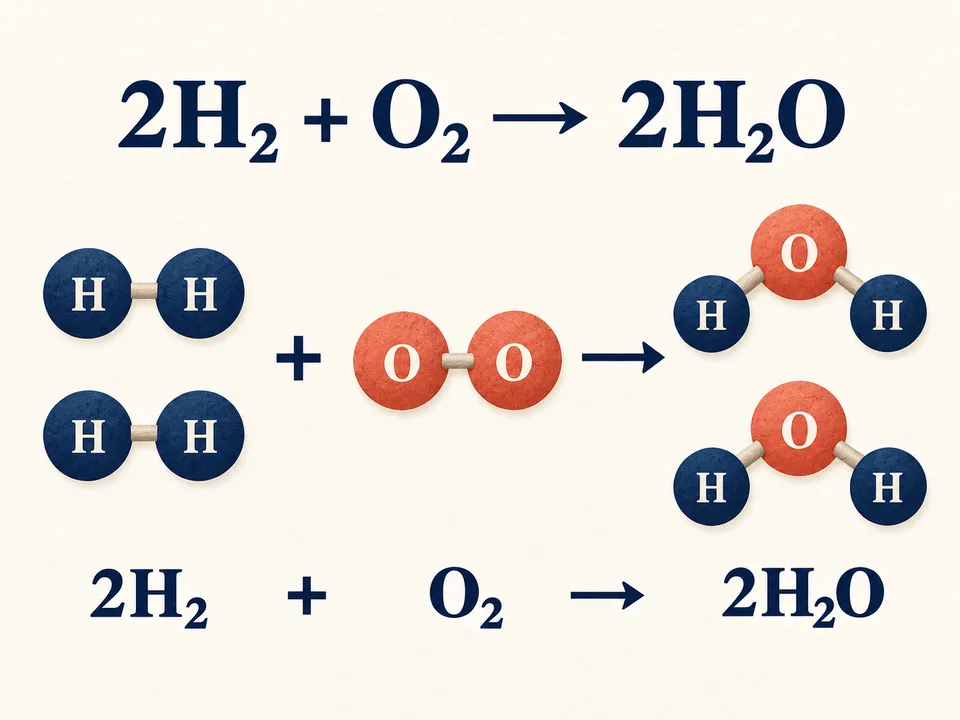
- Balance: 2H₂ + O₂ → 2H₂O.
- Use coefficients as mole ratios.
- Check the other reactant is sufficient before calculating a product.
Keep the plan realistic
Several subjects to prepare?
2-hour example · Mathematics is weaker
- Mathematics90 min
- Repair → practise → correct
- Physics30 min
- Recall → short practice
Missed a study day?
Use your familiar-topic review slot
- Recover
- Finish one blocked function question.
- Continue
- Practise today’s priority topic.
- Review
- Correct the error; plan a retry.
21-day checklists: your daily tasks
Mathematics
Day 1 is 21 days before your exam; Day 21 is the day before it.
Sets & functions
Week 1Trigonometry & sequences
Week 2Geometry & mock review
Week 3Day 1Week 1
Sets and Function Basics
Review set operations, domain and range. Explain the meaning of a function before solving a short question.
Day 2Week 1
Function Operations and Composition
Practise function operations and composition. Check the domain at each step.
Day 3Week 1
Inverse Functions and Symmetry
Review inverse functions, monotonicity and parity. Use the definitions to test examples.
Day 4Week 1
Linear and Quadratic Functions
Connect formulas with graphs, intercepts and turning points. Revisit rational-function restrictions.
Day 5Week 1
Power and Exponential Functions
Compare domains, graphs and growth. State the conditions before applying rules.
Day 6Week 1
Logarithms and Inequalities
Practise logarithm laws, domain checks and logarithmic inequalities.
Day 7Week 1
Trigonometry Basics
Review radians, the unit circle and standard-angle values. Retry an earlier function question.
Day 8Week 2
Trigonometric Identities
Use basic identities to transform expressions; explain which identity you chose.
Day 9Week 2
Sum, Difference, Double Angle & Half Angle Formulas
Review sum, difference, double-angle and half-angle formulas, then apply them without a formula prompt.
Day 10Week 2
Trigonometric Equations, Inequalities, and Modeling
Check solutions over the stated interval. Connect trigonometric equations and inequalities with a graph or model.
Day 11Week 2
Sequence Basics
Distinguish a term from a sum. Translate a pattern into sequence notation.
Day 12Week 2
Arithmetic Sequences
Practise the general term and sum. Check whether your indexing matches the question.
Day 13Week 2
Geometric Sequences
Practise the general term and sum, including relevant conditions on the ratio.
Day 14Week 2
Sequences and Inequalities
Choose between arithmetic and geometric methods. Revisit an inequality and a function error.
Day 15Week 3
Coordinate Geometry of Lines
Review slopes, line equations, intersections and distances in coordinates.
Day 16Week 3
Coordinate Geometry of Circles
Connect a circle’s equation with its centre and radius. Practise line–circle relationships.
Day 17Week 3
Conic Sections
Review the standard equations and basic properties of ellipses, hyperbolas and parabolas.
Day 18Week 3
Vectors and Complex Numbers
Review vector operations, the dot product and basic complex-number calculations.
Day 19Week 3
Permutations, Combinations, and Probability
Distinguish permutations from combinations and use them in probability questions. Explain your counting choices.
Day 20Week 3
Solid Geometry and Basic Derivatives
Check spatial coordinates, simple solids and basic derivative applications. Revisit weak topics if these need more than one session.
Day 21Week 3
Full Mock Test and Review
Review an earlier full mock, retry selected errors and confirm exam arrangements. Complete your first full attempt before this day.
Select a day to view its task. Double-click to check or uncheck it.
Even or odd? Look for symmetry.
Even: mirror across the y-axis
f(x) = x²
f(−x) = f(x)
Odd: rotate around the origin
f(x) = x³
f(−x) = −f(x)
Complete a full timed mock before Day 21, then review the errors and retry the questions you missed.
Repeating the same mistakes? Find the missing steps with a tutor.
Get tutoring helpPhysics
Day 1 is 21 days before your exam; Day 21 is the day before it.
Motion & forces
Week 1Energy, momentum & fields
Week 2Electricity, optics & review
Week 3Day 1Week 1
Kinematics Fundamentals
Identify the quantities in a motion question and explain what each one describes.
Day 2Week 1
Uniform Acceleration and Free Fall
Recognise an acceleration or free-fall situation before choosing a method.
Day 3Week 1
Newton's Laws of Motion
Identify the object being studied and explain which motion principle applies.
Day 4Week 1
Forces and Force Analysis
Draw the forces before starting a calculation; note any unclear interaction.
Day 5Week 1
Vector Addition and Forces
Check the direction of each force and how you would combine the effects.
Day 6Week 1
Projectile Motion and Circular Motion
Distinguish the motion models and explain why you selected one.
Day 7Week 1
Gravitation and Celestial Motion
Identify the objects and conditions in a gravitational-motion question.
Day 8Week 2
Work and Power
Distinguish work from power and state what the question asks you to find.
Day 9Week 2
Kinetic Energy and Work-Energy Theorem
Connect a change in motion with the energy method you would use.
Day 10Week 2
Potential Energy and Conservation of Mechanical Energy
Check whether your chosen energy approach fits the situation.
Day 11Week 2
Momentum and Impulse
Identify the system and the before-and-after quantities in an interaction.
Day 12Week 2
Conservation of Momentum
Explain which conditions need checking before using a conservation approach.
Day 13Week 2
Simple Harmonic Motion and Mechanical Waves
Distinguish an oscillation from a travelling wave and identify its quantities.
Day 14Week 2
Electric Field and Electric Field Strength
Read an electric-field situation and explain the direction you would analyse.
Day 15Week 3
Electric Potential and Electric Potential Energy
Distinguish potential from potential energy; record any confusing comparison.
Day 16Week 3
Circuit Fundamentals and Ohm's Law
Read the circuit before calculating and identify the quantity being requested.
Day 17Week 3
Electrical Power and Energy
Check what the electrical energy or power question is actually comparing.
Day 18Week 3
Magnetic Field and Lorentz Force
Identify the field, moving object and direction information in the setup.
Day 19Week 3
Electromagnetic Induction
Recognise the changing situation in an induction question before selecting a method.
Day 20Week 3
Optics
Draw the light path and check which optical situation is being described.
Day 21Week 3
Full Mock Test and Review
Review an earlier mock and retry recurring errors. Ask for feedback on unresolved models.
Select a day to view its task. Double-click to check or uncheck it.
Balanced or unbalanced? Add the forces first.
Balanced: zero net force
Fnet = 0
a = 0
Unbalanced: acceleration right
Fnet = 4 N
a = 2 m/s² →
For your next force question, draw the forces, choose a positive direction and find the net force before using Fnet = ma.
Unsure which formula fits? Work through the reasoning with a tutor.
Get tutoring helpChemistry
Day 1 is 21 days before your exam; Day 21 is the day before it.
Foundations & calculations
Week 1Structure, principles & acids
Week 2Experiments, organic & review
Week 3Day 1Week 1
States of Matter and Properties
Describe the material and distinguish the property or change being discussed.
Day 2Week 1
Pure Substances and Separation Methods
Identify the mixture and explain what a separation method needs to achieve.
Day 3Week 1
Metals, Acids, Bases, and Basic Reactions
Classify the substances and recognise the broad reaction being described.
Day 4Week 1
Balancing Chemical Equations
Check that your equation represents the substances and reaction consistently.
Day 5Week 1
Mole Concept and Avogadro's Number
Identify the quantity and unit in a mole question before calculating.
Day 6Week 1
Solution Concentration and Dilution
Distinguish concentration from amount and identify what changes during dilution.
Day 7Week 1
Gas Volume and Ideal Gas Law
Check the gas quantities and the conditions stated in the question.
Day 8Week 2
Atomic Structure and Electron Configuration
Connect particle structure with the information a question gives you.
Day 9Week 2
Periodic Table and Element Trends
Locate the elements and explain the trend you would compare.
Day 10Week 2
Oxidation Numbers and Redox Reactions
Identify what changes in a redox reaction and record uncertain classifications.
Day 11Week 2
Chemical Bond
Distinguish bonding questions from questions about the whole substance.
Day 12Week 2
Molecular Polarity and Intermolecular Forces
Check whether the question concerns molecular structure or interactions between particles.
Day 13Week 2
Reaction Rates and Equilibrium
Distinguish reaction-rate questions from equilibrium questions before selecting an approach.
Day 14Week 2
Acids, Bases, and pH
Identify the acid–base situation and explain what a pH question asks you to compare.
Day 15Week 3
Solubility and Solubility Curves
Read the conditions and axes before interpreting a solubility question.
Day 16Week 3
Galvanic Cells and Electrolysis
Identify the type of cell and the processes you need to analyse.
Day 17Week 3
Gas Preparation and Gas Testing Methods
Explain the aim of a gas-preparation or testing step, without copying a procedure.
Day 18Week 3
Metal Reactivity and Common Ion Tests
Use the stated observations to identify what needs checking about a metal or ion.
Day 19Week 3
Organic Chemistry Basics
Recognise the main type of organic question and list the ideas you still need explained.
Day 20Week 3
Organic Reactions and Biomolecules
Connect the reaction or biomolecule with its broad role; record unclear relationships.
Day 21Week 3
Full Mock Test and Review
Review an earlier mock and retry recurring errors. Ask for feedback on unresolved reasoning.
Select a day to view its task. Double-click to check or uncheck it.
Coefficient or subscript? Count what each means.
Coefficient: how many molecules
2H₂O
4 H + 2 O
Subscript: atoms in each molecule
H₂O
2 H + 1 O
Before using a reaction ratio, balance the equation and check the atom count on both sides.
Know the concepts but can’t apply them? Practise with a tutor.
Get tutoring helpMock review & exam-day preparation
Our CSCA Math mock–exam comparison explains the topic patterns and solving methods this practice is designed to build.
Finished a mock? Make it useful.
- 01
Attempt
Complete a timed paper. Mark uncertain answers, including correct guesses.
- 02
Diagnose
Sort the problem: knowledge, method, calculation or pacing.
- 03
Repair
Repair the blocking idea. Try a fresh question unaided.
- 04
Return
Retry the skill in a later mixed set.
- Couldn’t start?
- Return to the missing concept and an explained example.
- Chose the wrong method?
- Check its conditions; compare a contrasting question.
- Calculation slipped?
- Redo that step and add a specific check.
- Ran out of time?
- Time short sets of methods you already know.
Day 21
Keep the work light and the arrangements clear.
- Revisit your repeat errors and their corrections.
- Recall formulas with their conditions.
- Have your exam time, ID and test setup ready.
- Prepare what you need and leave time to rest.
With only two days left, use the final revision checklists to choose a smaller set of topics and recheck corrected errors.
Find exam dates in the CSCA exam schedule and booking steps in the CSCA registration guide.
Your next session, on one small card.
- 01Choose one priority topic.
- 02Try one question without notes.
- 03Fix one error and schedule a retry.
- 04Check your progress at week’s end.
Study with PrepPals
Connect with other CSCA learners or get help with the topics blocking your progress.

CSCA study-plan questions, answered
Is 21 days enough to prepare for CSCA?
Use 21 days for focused revision when you have already studied much of the required material. Begin with a diagnostic attempt, repair the essential gaps, and use weekly checkpoints to adjust. If several core topics are new, make foundation repair your priority and use the CSCA preparation guide to plan the larger route.
How many hours should I study each day?
Start with a 90-minute session for one subject: 10 minutes of recall, 20 of worked examples, 40 of practice and 20 of correction. Add sessions for your weaker required subjects. With less time, shorten each block and keep all four steps.
Does the plan cover Mathematics, Physics and Chemistry?
Yes. All three subjects have a weekly overview and a 21-day checklist, with topics, study goals and weekly outputs. Use the subject plans alongside the daily study loop, and adjust the topic order to your diagnostic results.
Should I do a full mock every day?
Alternate targeted topic practice with timed attempts. After each mock, identify the error type, repair the underlying step and retry it in a fresh question. Complete your first full mock before Day 21 to leave time for correction.
Can I use the plan for only one subject?
Yes. Select Mathematics, Physics or Chemistry and follow its weekly route and daily checklist.
What if I have a weak math foundation?
Slow down where the method is unclear. Study a worked example, close the solution and try a similar question. You may need to repeat a day or focus on fewer topics. See the PrepPals math foundation guide for a more detailed way to diagnose and repair gaps.
CSCA syllabi & study-method research
Written by: PrepPals Academic Team
Subject coverage follows the CSCA syllabi. The study routine draws on research into retrieval, worked examples and spaced practice.
- [1] CSCA Mathematics Examination Syllabus ↗
Mathematics syllabus from the CSCA official test-preparation portal.
- [2] IES / What Works Clearinghouse: Organizing Instruction and Study to Improve Student Learning ↗
The 2007 guide recommends spaced learning, active retrieval and alternating worked examples with independent problem solving. These actions shape the daily study loop.
- [3] CSCA official test-preparation portal ↗
Current official syllabi and exam requirements.
- [4] Dunlosky et al. (2013): Effective Learning Techniques ↗
Research review: practice testing and distributed practice received high utility assessments. It informs the closed-note recall and repeat visits in this plan.
- [5] CSCA Physics Examination Syllabus ↗
Physics syllabus from the CSCA official test-preparation portal.
- [6] CSCA Chemistry Examination Syllabus ↗
Chemistry syllabus from the CSCA official test-preparation portal.
How we turn research into practice
PrepPals developed the daily routes, weekly checkpoints and 90-minute study routine.
Learning sources checked: